Shortlands Skip Hire: Recycling and Sustainability in the Eco-Friendly Waste Disposal Area
Welcome to the sustainability overview for Shortlands Skip Hire, where our focus is on creating a truly eco-friendly waste disposal area and a long-term vision for a sustainable rubbish area across Shortlands and neighbouring boroughs. We combine practical skip hire services with progressive recycling practices, partnerships and low-carbon logistics to turn waste into a resource. Our approach balances efficient site management with community reuse and local regulations on waste separation.As a local provider of Shortlands skips and waste services, we align our operations with the boroughs' approach to recycling: separate food waste, paper and card, glass, cans and plastics, plus garden waste collections where available. That means our on-site sorting systems and customer guidance encourage correct segregation at source, reducing contamination and improving recovery rates. By supporting both household-style separation and commercial mixed collections, our eco-friendly waste disposal area is designed to integrate with municipal schemes while offering additional reuse pathways.

Our Recycling Percentage Target and Measurable Goals
We have set a clear recycling percentage target of 70% diversion from landfill by 2030 across all skip streams under our management. This target covers recycling, reuse and recovery and is monitored through weight-based reporting and transfer station documentation. Regular audits of loads delivered to local transfer stations ensure transparency; we measure the fraction of material sent to materials recovery facilities (MRFs), reprocessors and charity partners to track progress toward our sustainable rubbish area goals.Local Transfer Stations and Materials Routes
We work closely with nearby transfer stations and reprocessing hubs — including the Bromley Transfer Station and regional South East London transfer facilities — to keep materials moving through the correct channels. Our routing strategy emphasises short haul movements to authorised transfer points and MRFs to minimise emissions. At each stage, documentation records tonnages and destination codes so we can report recycling rates accurately and verify that materials from our skips are recovered wherever practical.To support reuse and the circular economy we maintain direct relationships with a range of household and construction waste reprocessors. Typical recycling activity in the area includes separate processing streams for:
- mixed dry recycling (paper, card, cans, plastics)
- glass and clear/coloured separation
- food and organic waste where local collections permit
- construction and demolition materials such as hardcore, bricks and reclaimed aggregates
- metal, wood and textiles recovery
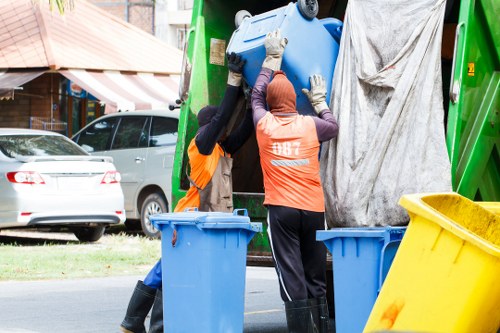 Partnerships with Charities and Community Reuse — our commitment extends beyond mechanical recycling. We have established partnerships with national charities (for example, charity-owned furniture and clothing re-use outlets) and local community organisations to divert reusable items away from disposal. When customers identify reusable furniture, fixtures or usable building materials in a skip, we work to direct those goods to charity partners or social enterprises that operate local reuse shops and refurbishment workshops.
Low-Carbon Vans and Fleet Initiatives
Our fleet strategy is a core part of delivering an eco-friendly waste disposal area. Shortlands Skip Hire operates a mix of electric vans, hybrid vehicles and low-emission Euro 6 trucks, supplemented by route optimisation software to reduce mileage and idling. Telematics and driver training lower fuel use and improve safety; where fully electric vehicles are not yet practical we use low-carbon biofuel blends and ensure regular maintenance to keep emissions minimal.The benefits are tangible: fewer trips to transfer stations per tonne, reduced local air pollution, and lower CO2 per job. These measures support our recycling percentage target by making frequent local collections viable and affordable, meaning materials are picked up, sorted and dispatched quickly to recovery facilities rather than being stored or landfilled.
 On-site Sorting and Sustainable Rubbish Area Design — our sites are designed with segregation in mind. Dedicated bays for different waste types, clear signage, and staff-led sorting reduce contamination. Where feasible we install wheel-wash stations and covered storage to protect materials from weather, improving the quality of recyclables. This operational design complements borough separation schemes and helps materials meet reprocessor acceptance criteria.
Community Programmes and Future Commitments
We support community clearance days, furniture reuse drives and local building projects that benefit from reclaimed materials. By collaborating with councils and charities, we build circular supply chains: recovered aggregates return to landscaping projects, timber is reclaimed for social housing repairs, and textiles are channelled to reuse stores. Our Shortlands recycling services therefore serve both environmental and social purposes.Looking forward, our plan includes increased fleet electrification, more on-site material recovery infrastructure, and expanding charity networks to ensure that bulky good items get a second life. We will publish annual recycling performance reports and pursue continuous improvement through staff training, customer education and investment in low-carbon technologies. Together with residents and businesses, Shortlands waste disposal can be transformed into a sustainable rubbish area that meets the needs of the community while protecting local green spaces for future generations.
Our pledge: continue reducing landfill dependency, meet or exceed our 70% diversion target by 2030, and keep evolving our sustainable operations to support a greener Shortlands and surrounding boroughs.